


Pet Food Pouch Packaging: A Practical Guide to Sizes, Formats and Materials
Choosing a pouch for pet food is a series of small, connected decisions. Fill weight, product characteristics, barrier needs, closure type and distribution conditions all influence each other rather than being chosen independently. This guide answers specific, practical questions that come up when a brand or packaging buyer moves from “we need a bag” to a validated pouch specification.
Quick-Selection Guide
| Pet food type | Typical fill size | Formats commonly considered | Main packaging concern |
|---|---|---|---|
| Dry dog food (kibble) | 500 g – 2 kg | Stand-up pouch, flat-bottom pouch | Moisture barrier, puncture resistance |
| Dry dog food (kibble) | 3 kg – 10 kg+ | Flat-bottom pouch, side-gusset bag | Seal and mechanical strength, shelf/pallet stability |
| Dry cat food | 500 g – 3 kg | Stand-up pouch, flat-bottom pouch | Moisture barrier, reclosure |
| Semi-moist or high-fat treats | 100 g – 500 g | Stand-up pouch, flat pouch | Oxygen/aroma barrier, grease resistance |
| Freeze-dried treats | 50 g – 300 g | Stand-up pouch, flat-bottom pouch | Moisture barrier, product fragility |
| Hard or sharp treats (bones, jerky) | 100 g – 1 kg | Stand-up pouch, flat-bottom pouch | Puncture resistance |
This table reflects common industry practice, not fixed rules. The correct format for any specific product should be confirmed against the actual product and fill line.
Choosing a Pouch Format by Fill Weight and Product Type
What pouch format works for 5 kg of dry dog food?
For 5 kg of dry dog food, flat-bottom pouches and side-gusset bags are usually stronger candidates than small stand-up pouches, because the package has to support substantially more product weight during filling, handling and transport. The final choice depends on the kibble shape, film structure, seal design, filling equipment and how the product will be shipped and stored.
Flat-bottom pouches provide a wide base that helps the filled pack stand upright on a shelf or pallet even at higher weights. Side-gusset bags can hold a comparable volume efficiently and are commonly used for large dry-food formats where shelf presentation matters less than fitting product into cartons and on pallets efficiently.
At this fill weight, mechanical performance, seal strength, drop resistance and puncture resistance, typically matters more than it does for a smaller pack, because a heavier fill puts more stress on the seals and the film during a drop or a rough handling event.
What pouch format works for 1 kg of dry dog food?
Stand-up pouches and flat-bottom pouches are both routinely used for 1 kg of dry dog food. At this weight, either format can usually provide adequate shelf stability and mechanical strength, so the decision often comes down to shelf presentation, reclosure preference and cost rather than a hard technical limit.
A stand-up pouch with a wide base and gusseted sides can stand upright and display well on a shelf. A flat-bottom pouch offers a squarer profile that some brands prefer for shelf blocking or a premium look. Neither format is inherently superior at 1 kg; the difference tends to be aesthetic and logistical rather than structural.
What pouch format is suitable for 100–500 g of pet treats?
Stand-up pouches are the most common format for 100–500 g of pet treats, largely because the fill weight is light enough that mechanical stress on the pouch is limited, which gives more flexibility in film choice and pouch shape. Flat pouches are also used, particularly for flatter or thinner treat products.
At this weight range, barrier performance, oxygen and moisture protection for aroma and freshness, and closure convenience, whether the consumer needs to reclose the bag between uses, usually matter more to the packaging decision than mechanical strength.
Is a flat-bottom pouch better than a stand-up pouch for heavy pet food?
Flat-bottom pouches are generally considered a stronger option than small stand-up pouches for heavier pet food fills because their wider base distributes weight more evenly and supports better shelf and pallet stability. "Better" here is specific to stability and handling at higher weights, not a universal ranking.
A standard stand-up pouch design that works well at 500 g may not hold its shape or resist tipping as effectively once filled to several kilograms. Flat-bottom construction was developed partly to address this by giving the pack a more rigid, self-supporting base.
This does not mean stand-up pouches cannot be engineered for heavier fills. Some stand-up pouch designs are reinforced specifically for higher weights. The comparison depends on the specific pouch construction, not the format name alone.
When should a side-gusset bag be used instead of a flat-bottom pouch?
Side-gusset bags are commonly considered when a brand needs to fit a larger volume of product efficiently into a given carton or pallet footprint, rather than prioritizing shelf-display stability. They are frequently used for larger dry pet food formats sold in bulk or through channels where shelf presentation is a lower priority than case-pack efficiency.
Flat-bottom pouches tend to be chosen when upright shelf stability and a wider, more premium-looking base are priorities, such as retail shelf placement. Side-gusset bags can also make efficient use of shipping space because their profile stacks and packs differently than a flat-bottom pouch.
The decision generally comes down to where the product will be sold and how it will move through the supply chain, not a fixed rule tied to weight alone.
How does increasing pet food fill weight change the pouch requirements?
As fill weight increases, mechanical stress on the pouch increases correspondingly, which typically raises the requirements for seal strength, film strength and puncture resistance. A heavier fill places more force on seals during handling, stacking and drops, so a structure that performs adequately at 500 g cannot be assumed to perform the same way at 5 kg.
Base stability also becomes more important at higher weights, which is part of why flat-bottom and side-gusset formats are more commonly used for larger dry pet food fills than small stand-up formats. Filling and sealing equipment requirements can change too, since heavier fills often need different filling speeds or seal dwell times to form a consistent seal.
None of this scales in a simple linear way. Increasing fill weight from 1 kg to 5 kg does not mean film thickness or seal strength needs to increase by the same factor; the actual requirement depends on the specific film structure, kibble characteristics and distribution conditions, and should be validated with the filled product rather than calculated from weight alone.
What packaging works for large bags of dry cat food?
Large bags of dry cat food, generally in the multi-kilogram range, follow the same logic as large-format dry dog food: flat-bottom pouches and side-gusset bags are more commonly used than small stand-up formats, because of the added mechanical stress and stability needs at higher fill weights.
Moisture barrier remains important regardless of pet species, since dry kibble for cats is similarly susceptible to moisture uptake affecting texture and shelf life. The core packaging decisions, format, barrier, seal strength, closure, are largely the same considerations used for large dry dog food formats.
Seal Strength, Thickness and Shipping Performance
How thick should a pouch for 5 kg of dog food be?
There is no universal film thickness that applies to a 5 kg dog food pouch. Required thickness depends on the film structure, kibble geometry, drop resistance requirements, seal design, filling process and distribution conditions.
Two different 5 kg pouches, one made from a multilayer laminate and one from a mono-material structure, may need different thicknesses to achieve the same mechanical performance, because different materials and layer combinations provide different strength per unit of thickness. Kibble with sharp edges also generally increases puncture resistance requirements compared with smoother kibble shapes, independent of fill weight.
A packaging supplier should validate the final film structure and thickness against the actual filled and sealed product under realistic handling and shipping conditions, rather than selecting a thickness figure based on fill weight alone.
Does a 5 kg dog food pouch need stronger seals than a 500 g pouch?
Yes, in general a 5 kg pouch needs stronger seals than a 500 g pouch, because the seal has to withstand significantly more force during handling, stacking and drop events at higher fill weights. Seal strength requirements scale with the mechanical stress the pack will experience, not simply with product volume.
Seal strength is influenced by sealant material, seal width, sealing temperature, dwell time and pressure during manufacturing, in addition to fill weight. A heavier pouch may require a wider seal, a different sealant layer, or tighter process control to consistently achieve adequate seal strength across production.
What causes pet food pouch seals to fail?
Pouch seals typically fail due to contamination in the seal area (product particles, dust or oil trapped in the seal), insufficient sealing temperature or pressure, incorrect dwell time, or mechanical stress exceeding the seal's design strength during handling or shipping. Fat or oil migrating into the seal area is a known contributor in oily pet food products specifically.
Seal failure can also result from film defects, inconsistent film thickness, poor material handling before sealing, or from a seal design that was not validated for the actual fill weight and distribution conditions of the finished product. Identifying the specific cause typically requires inspecting failed seals directly rather than assuming a single explanation.
How can pet food brands reduce pouch failures during shipping?
Reducing shipping-related pouch failures generally starts with validating the filled and sealed pouch under realistic distribution testing, drop testing, vibration testing and compression testing that reflect the actual shipping path, rather than relying on the pouch specification alone. A structure that performs well in a lab test but has not been tested under real distribution conditions can still fail in transit.
Seal integrity, film strength and headspace all interact with shipping performance. Adequate headspace reduces the risk of product shifting and stressing the seal during handling, while consistent seal quality reduces the risk of a weak point failing under vibration or compression. Carton design and how pouches are packed together also affects how much mechanical stress individual pouches experience during transport.
Does e-commerce distribution require stronger pet food packaging than standard retail distribution?
E-commerce distribution often involves more individual handling events, drops and compression exposure than palletized retail distribution, which can justify a stronger or more thoroughly validated pouch structure for products shipped directly to consumers. A pouch that performs adequately moving through a retail supply chain on a pallet is not automatically validated for single-parcel shipping, where it may be dropped, thrown or compressed individually without the surrounding support of a full case.
Whether a stronger structure is actually needed depends on the specific product, the packaging's current performance margin and the carrier's typical handling conditions, not a blanket rule that e-commerce always requires heavier packaging.
Is a flat-bottom pouch more stable on the shelf than a stand-up pouch when filled with several kilograms?
Flat-bottom pouches are generally more stable than standard stand-up pouches once filled with several kilograms of product, because their base is engineered specifically to distribute weight across a wider, flatter footprint. This is one of the main reasons flat-bottom construction is commonly used for heavier dry pet food formats.
A stand-up pouch not specifically reinforced for higher fill weights can become less stable and more prone to tipping as fill weight increases, since its base was often originally designed around lighter fills. This is a general tendency rather than an absolute rule, since stand-up pouch designs vary.
How does kibble shape affect puncture resistance requirements?
Kibble with sharp edges, irregular shapes or hard surfaces generally increases the puncture resistance requirement for the packaging film compared with smoother, more rounded kibble shapes. Sharp product edges pressing against film during handling, stacking or transport increase the risk of pinholes or tears at weak points in the structure.
This is why puncture resistance is typically evaluated against the actual product rather than assumed from a generic film specification. A film structure validated for one kibble shape and hardness is not automatically appropriate for a different, sharper product without separate validation.
Barrier Requirements for Dry Food, Fats and Freeze-Dried Products
What barrier properties does dry dog food packaging need?
Dry dog food packaging generally needs moisture barrier, to prevent moisture uptake that can cause texture changes, clumping or mold risk, and oxygen barrier, to slow fat oxidation that leads to rancidity and off-flavors. Aroma barrier is also relevant, both to retain the product's own aroma and to prevent external odors from being absorbed through the packaging.
The specific level of barrier needed depends on the product's fat content, target shelf life, packaging environment and distribution conditions. A lower-fat, shorter-shelf-life product generally needs less oxygen barrier than a high-fat product with a long shelf-life claim, though the exact requirement should be established through shelf-life testing rather than assumed from category alone.
Does high-fat dog food need a higher oxygen barrier?
Yes, high-fat dry dog food generally needs a stronger oxygen barrier than lower-fat formulations, because fat oxidation is a primary driver of rancidity, off-flavors and reduced shelf life in pet food. Higher fat content increases the amount of oxidizable material in the product, which increases sensitivity to oxygen exposure over time.
The exact barrier level required depends on the specific fat content, the type of fat, any added antioxidants in the formulation, and the target shelf life. This is typically established through accelerated shelf-life testing on the actual product rather than assumed from a general fat-content threshold.
Why can pet food fats become a packaging problem?
Pet food fats can migrate into the packaging film itself over time, particularly at the seal area, which can weaken seal integrity and, in some cases, affect the film's barrier performance. This is sometimes referred to as grease or fat strike-through.
Fats are also chemically reactive with oxygen, so their presence increases the practical importance of a package's oxygen barrier, since oxidized fat is what causes rancidity, changes in taste and aroma degradation in pet food. Packaging for higher-fat products generally needs both a suitable barrier structure and a sealant layer resistant to fat migration.
Does dry kibble need a moisture barrier?
Yes, dry kibble generally needs a moisture barrier, because moisture uptake can cause texture changes, clumping, and create conditions that support mold growth, all of which shorten usable shelf life. This applies across most dry pet food products, not only premium or higher-fat formulations.
The required level of moisture barrier depends on the product's initial moisture content, the target shelf life, and the humidity conditions the product is likely to encounter during storage and distribution. Products intended for humid climates or long storage periods generally need a stronger moisture barrier than products with shorter, climate-controlled distribution.
Does freeze-dried pet food require different barrier protection from ordinary dry kibble?
Freeze-dried pet food is typically more moisture-sensitive than ordinary dry kibble, because the freeze-drying process removes most of the product's moisture and leaves a porous structure that can reabsorb moisture from the environment relatively easily. This generally makes moisture barrier a more critical requirement for freeze-dried products than for conventional kibble.
Freeze-dried products can also be more physically fragile than kibble, which raises separate considerations around cushioning and handling, though this is a product-handling concern more than a film-barrier concern. The appropriate barrier and structure should be validated against the specific freeze-dried product and its target shelf life.
What packaging considerations matter for oily dog treats?
Oily dog treats raise similar concerns to high-fat kibble: oxidation risk requiring adequate oxygen barrier, and fat migration risk that can affect seal integrity over time, sometimes described as grease strike-through. A sealant layer with good fat resistance is typically an important part of the structure for these products.
Aroma containment is often a practical concern as well, both to preserve the product's own smell and to prevent strong odors from affecting other products stored nearby. The specific structure needed depends on the fat content and type, and target shelf life, of the treat formulation.
Closures, Materials and Recyclability
Should a large dog food pouch have a zipper, and does it affect barrier or recyclability?
Whether a large dog food pouch should have a zipper generally depends on whether the product is intended to be reclosed and used over multiple feedings, which is common for large dry food formats sold for repeated use at home. A zipper adds practical value for consumers managing a multi-kilogram bag over days or weeks.
Adding a zipper can affect both barrier performance and recyclability, depending on the zipper material and how it's integrated into the pouch. A zipper made from a different polymer than the rest of the pouch can complicate mono-material recyclability, since recycling streams generally require the bulk of the package to be a single, separable material. Zipper components can also create a potential weak point in the pouch's barrier if not properly integrated into the film structure.
Can recyclable mono-material PE be used for dry pet food?
Mono-material PE structures are used for some dry pet food applications, particularly where the required barrier level is moderate and the product's shelf-life and fat-content profile don't demand the highest levels of oxygen barrier. Whether a specific product can use a mono-material PE structure depends on its individual barrier requirements.
Mono-material structures are designed to be more compatible with existing plastic recycling streams than mixed-material laminates, because a single polymer type is easier to sort and reprocess. This does not mean every dry pet food product is automatically suited to mono-material PE; higher-fat, higher-oxygen-sensitivity, or very long shelf-life products may still require barrier performance that is more readily achieved with a multilayer structure.
Can recyclable packaging provide enough barrier for high-fat pet food?
This depends heavily on the specific recyclable structure and the specific product's fat content and shelf-life target. Some mono-material and other recyclable structures have been developed with added barrier layers or coatings specifically to extend their oxygen and moisture performance, but recyclable structures do not automatically match the barrier ceiling of traditional multilayer laminates in every case.
The appropriate way to answer this for a specific product is to test the candidate recyclable structure against the actual formulation and target shelf life, rather than assuming recyclable and conventional structures are interchangeable at every barrier level.
Can PCR material be used in pet food packaging?
Post-consumer recycled (PCR) content can be used in pet food packaging, but recycled content and recyclability are different properties and shouldn't be conflated. Recycled content refers to how much of the package's material comes from previously recycled plastic; recyclability refers to whether the finished package itself can realistically be recycled again after use.
A pouch can contain PCR material and still not be easily recyclable if it's built as a mixed-material laminate. Conversely, a mono-material recyclable pouch may or may not contain any PCR content at all. These are separate specifications that should be discussed separately when defining packaging requirements.
Can PCR material directly contact pet food?
Whether PCR material can be used in direct food or pet-food contact depends on the specific recycling process the material went through and the food-contact regulations of the country where the product will be sold. In general, food-contact applications typically require recycled content that has gone through a recognized food-grade recycling process, rather than any recycled plastic being automatically acceptable for direct contact.
This is a regulatory compliance question that varies by jurisdiction and should be confirmed directly with the material supplier and against the applicable food-contact regulations for each specific market before finalizing a structure, rather than assumed as a general rule.
Are recyclable pet food pouches actually recyclable everywhere?
No, a pouch being designed for recyclability does not mean it will actually be collected and recycled everywhere it's sold. "Designed for recycling" describes the package's material composition and structure; whether it's actually recycled depends on local collection programs, sorting facility capabilities, and whether an end market exists for the reprocessed material in that specific region.
Flexible plastic packaging in particular is not accepted in curbside recycling in many areas, even when the package itself is technically recyclable in facilities equipped to handle it. Brands making recyclability claims should be specific about where the claim applies rather than presenting the package as universally recyclable.
Material Efficiency and Practical Filling Questions
Which pouch format uses less material for the same amount of pet food?
This depends on the specific dimensions and structure being compared, and there is no single format that always uses less material for a given fill weight. Side-gusset bags can be efficient in material use per unit volume for larger fills because of how their geometry uses film area, but the actual comparison depends on the specific pouch dimensions, film thickness and fill weight being evaluated.
A fair material comparison generally requires comparing specific pouch designs at the same fill weight and target performance level, rather than assuming one format name is inherently more material-efficient than another.
What packaging considerations matter for sharp or hard treats?
Sharp or hard treats, such as bones, hard chews or certain jerky-style products, generally increase puncture resistance requirements compared with softer or more uniformly shaped products. The film structure needs to withstand direct pressure and edges pressing against it during filling, stacking and transport without developing pinholes or tears.
Puncture resistance in flexible film generally comes from a combination of film thickness, material choice and film orientation, rather than thickness alone. A film validated for smooth kibble is not automatically adequate for a sharp-edged treat product without separate testing.
How much empty space (headspace) should be left above pet food before sealing?
There is no fixed headspace percentage that applies universally to pet food pouches. Required headspace depends on the filling equipment, sealing method, product characteristics (density, particle size, tendency to shift), and how much room the seal jaws need to form a clean, contamination-free seal.
Too little headspace increases the risk of product particles or oil getting trapped in the seal area, which is a common cause of seal failure. Too much headspace can waste packaging material and reduce shelf/case efficiency. The correct headspace for a specific product and pouch is typically determined during filling line trials rather than set from a general guideline.
Working With a Pouch Manufacturer
What information should a pet food brand give a pouch manufacturer before requesting a quotation?
Providing complete product and requirement details upfront generally leads to a more accurate quotation and fewer revisions later in development. A practical checklist includes:
Product type (dry kibble, treats, freeze-dried, etc.) and fat content
Target fill weight
Product density or bulk characteristics, if known
Desired shelf life
Preferred pouch format (stand-up, flat-bottom, side-gusset, flat, spouted)
Approximate pouch dimensions, if already determined
Barrier requirements or target shelf-life conditions
Closure requirements (zipper, resealable, one-time seal)
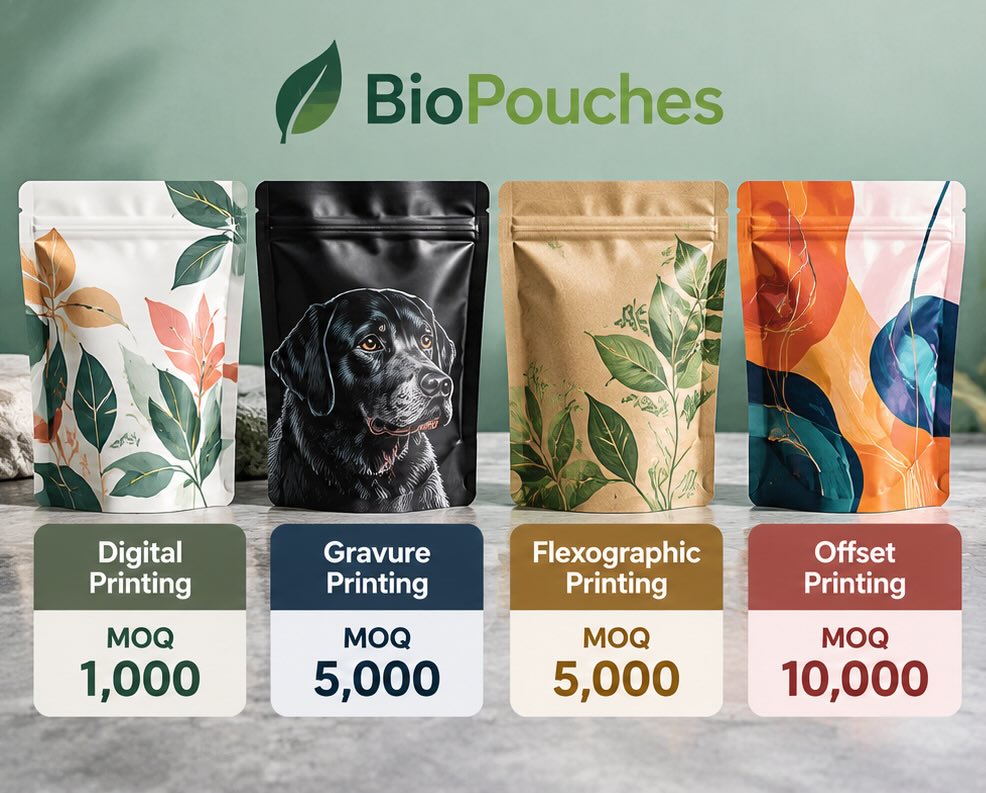
Printing requirements (number of colors, finish, branding needs)
Order quantity and expected reorder frequency
Filling and sealing equipment being used or planned
Distribution conditions (retail, e-commerce, export, climate exposure)
Any sustainability requirement (recyclable, PCR content, compostable)
Brands moving from format and material questions like these into specification and production can review BioPouches' custom pet food packaging options as a next step.
Pet Food Pouch Packaging FAQs
What pouch format works for 5 kg of dry dog food?
Flat-bottom and side-gusset formats are generally stronger candidates than small stand-up pouches for 5 kg of dry dog food, because the package needs to support more weight during filling, handling and transport. The exact choice depends on the kibble, film structure and distribution conditions, and should be validated with the filled product rather than selected by weight alone.
Can mono-material PE be used for dry pet food?
Mono-material PE is used for some dry pet food products, particularly where barrier requirements are moderate rather than very high. Higher-fat or long-shelf-life products may still need barrier performance more readily achieved with a multilayer structure, so suitability depends on the specific product.
Does high-fat dog food need a higher oxygen barrier?
Yes, generally. Higher fat content increases sensitivity to oxidation, which causes rancidity and off-flavors, so high-fat products typically need stronger oxygen barrier than lower-fat products. The exact barrier level should be confirmed through shelf-life testing on the specific formulation.
Should a 5 kg dog food pouch have a zipper?
Whether to add a zipper depends mainly on whether the product is intended to be reclosed across multiple feedings, which is common for large dry food formats used at home. A zipper's material also affects recyclability, since a different polymer zipper can complicate mono-material recycling.
Does freeze-dried pet food need high-barrier packaging?
Freeze-dried pet food is generally more moisture-sensitive than ordinary dry kibble, because the freeze-drying process leaves a porous structure prone to reabsorbing moisture. This typically makes moisture barrier a higher priority for freeze-dried products than for conventional kibble.
Can PCR material touch pet food?
Whether PCR material can be used in direct food contact depends on the specific food-grade recycling process it went through and the food-contact regulations of the country where the product is sold. This should be confirmed with the material supplier and against applicable regulations for each specific market, not assumed as a general rule.
Are recyclable pet food pouches actually recyclable everywhere?
No. A package being designed for recyclability doesn't guarantee it will be collected and recycled in every location, since that depends on local collection programs, sorting facilities and end markets for the material. Flexible plastic packaging specifically is not accepted in curbside recycling in many areas even when technically recyclable.
Does a 5 kg dog food pouch need stronger seals than a 500 g pouch?
Yes, generally. Seal strength requirements scale with the mechanical stress a pouch experiences during handling and shipping, and a heavier fill puts more force on the seal, so a 5 kg pouch typically needs a stronger, more carefully validated seal than a 500 g pouch.
What causes pet food pouch seals to fail?
Common causes include product or oil contamination trapped in the seal area, insufficient sealing temperature, pressure or dwell time, film defects, or mechanical stress exceeding the seal's design strength during shipping. Identifying the actual cause typically requires inspecting failed seals directly.
Does dry kibble need a moisture barrier?
Yes, generally. Moisture uptake in dry kibble can cause texture changes, clumping and mold risk, so most dry kibble products need some level of moisture barrier. The required strength depends on the product's initial moisture content, target shelf life and expected storage humidity.
What pouch format is suitable for 100–500 g of pet treats?
Stand-up pouches are the most common choice for this weight range, since the lighter fill limits mechanical stress and allows more flexibility in film and format choice. Barrier performance and reclosure convenience typically matter more than mechanical strength at this weight.
Can recycled content and recyclability be the same thing?
No, they're different properties. Recycled content (PCR) describes how much of a package's material came from previously recycled plastic. Recyclability describes whether the finished package can realistically be recycled again after use. A package can have one property without the other.
Key Takeaways
Pouch format for dry pet food is driven mainly by fill weight and mechanical stress: flat-bottom and side-gusset formats suit larger dry-food fills, while stand-up and flat pouches suit lighter fills and treats.
Barrier requirements (oxygen, moisture, aroma) depend on product fat content, moisture level and target shelf life, not on category assumptions alone, and should be confirmed through shelf-life testing.
Recyclable and recycled-content (PCR) are separate properties, and "designed for recycling" does not guarantee a package is actually collected and recycled in every market.
Numerical specifications, film thickness, seal strength, headspace, should be validated against the specific product and filling/sealing process rather than assigned from fill weight or category alone.
Distribution conditions, especially e-commerce versus palletized retail, materially affect how much mechanical and barrier performance a pouch actually needs.
Flexible Packaging Expert at BioPouches
Asad Manan has over 6 years of hands-on experience in flexible packaging at BioPouches. He specializes in beauty product, Coffee, Food-Snacks, and health products packaging solutions that protect sensitive formulas and extend shelf life. With strong content writing skills, he creates practical guides to help brands choose the right packaging for stability, hygiene, and sustainability.
Latest News