

BioPouches Explained: Answers to the Most Common Flexible Packaging Questions
BioPouches is XWPAK's specialized flexible packaging brand, producing custom pouches and flexible packaging formats for categories including coffee, pet food, snacks, frozen foods, health and beauty, and other consumer products. We work with brands ranging from first-time product launches to established companies replacing existing packaging. This page answers the practical questions we hear most often, covering pouch formats, minimum order quantities, printing methods, materials, certifications, and how to start a custom project. Each answer is written to stand on its own, so you can jump to the section relevant to your project.
BioPouches at a Glance
| Company | BioPouches |
| Parent / group | XWPAK (founded Shanghai, 2009) |
| Specialization | Custom flexible packaging and pouches |
| Main packaging formats | Flat bottom, gusseted, stand-up, flat, spouted pouches, rollstock |
| Digital printing MOQ | From approximately 500 units on qualifying projects |
| Gravure printing MOQ | From approximately 3,000 units (flat bottom pouches) |
| Printing | Digital and gravure (up to 10 colors) |
| Coffee packaging | Yes, including degassing valve options |
| Pet food packaging | Yes |
| Snack packaging | Yes, including jerky |
| Recyclable options | Yes, for suitable structures |
| Compostable options | Yes, within certified scope |
| PCR options | Yes, where suitable |
| BPI certification | Certificate #10529578-1 (defined scope) |
| DIN CERTCO registrations | 7P1758 and 9G0527 (defined scope) |
| Paper tube sister brand | Earthycores |
How BioPouches Fits Within XWPAK
BioPouches is part of the XWPAK packaging group. XWPAK was founded as a family packaging business in Shanghai in 2009, and BioPouches was launched that same year as its specialized flexible packaging brand, focused on custom pouches and sustainable material options including recyclable and compostable structures. The group later launched Earthycores in 2012 as a second specialized brand, focused specifically on custom paper tube and paper canister packaging rather than flexible pouches.
In practice, this means buyers looking for flexible pouches, bags, or rollstock work through BioPouches, while buyers looking for rigid, cylindrical paper-based packaging can explore Earthycores' custom paper tube packaging instead. You can read more about how the two brands relate to each other and to XWPAK on our XWPAK company history page.
BioPouches' manufacturing, production, quality control, and R&D operations are based in China. Alongside this, BioPouches maintains additional R&D capabilities, office and customer-support functions, and warehouse and stocking support in Canada, which serves customers working with our Canada-based team.
About BioPouches
What is BioPouches?
BioPouches is a flexible packaging manufacturer within the XWPAK packaging group, producing custom pouches and flexible packaging for coffee, pet food, snacks, frozen foods, health and beauty products, and other consumer goods. We work directly with brands on pouch format, material, printing, and closure specifications for their specific products.
Is BioPouches a manufacturer or a packaging reseller?
BioPouches manufactures flexible packaging rather than reselling pre-made stock from other producers. Our team works through material selection, structural specification, printing, and production for each custom project, rather than sourcing finished pouches from third parties and relabeling them.
Is BioPouches part of XWPAK?
Yes. BioPouches was launched by XWPAK in 2009 as its specialized flexible packaging brand. XWPAK is the broader packaging group; BioPouches is the group's dedicated pouch and flexible film specialist.
Where does BioPouches manufacture, and where are its offices located?
BioPouches manufacturing and production take place in China, where operations include manufacturing, production, quality control, and R&D. BioPouches also maintains R&D capabilities in Canada, along with an office, customer-support functions, and warehouse or stocking support based there. Manufacturing itself takes place in China; the Canada operations support R&D, customer service, and regional stocking rather than production.
What is the relationship between BioPouches, XWPAK and Earthycores?
XWPAK is the parent packaging group, founded in Shanghai in 2009. BioPouches is XWPAK's flexible packaging and pouch specialist, launched the same year. Earthycores is a separate specialized brand within the same group, launched in 2012 to focus on custom paper tube and paper canister packaging. Neither brand is a subsidiary of the other; both operate as specialized brands within XWPAK.
Products and Pouch Formats
What types of flexible packaging does BioPouches manufacture?
BioPouches manufactures flat bottom pouches, gusseted pouches, stand-up pouches, flat pouches, spouted pouches, and rollstock flexible films. You can review the complete range on our all products page. Format selection depends on the product being packaged, its fill weight, and how it will be displayed or distributed.
What pouch formats does BioPouches offer?
Our core formats include flat bottom pouches, gusseted pouches, stand-up pouches, and flat pouches. Each format suits different filling methods, shelf display needs, and product characteristics, so the right choice depends on the specific product and how it will be sold.
Can BioPouches manufacture custom pouch sizes?
Yes. Custom sizing is available across our pouch formats. Dimensions are typically set based on the product's fill weight, volume, and density, since the same weight of product can require different pouch dimensions depending on how densely it packs. A powder and a bulkier, lower-density product at the same weight will often need noticeably different pouch volumes to fit and seal correctly.
How does fill weight affect pouch sizing and structure?
Heavier fills generally increase the mechanical stress a pouch has to withstand during filling, handling, and shipping, which affects seal strength requirements, film strength, and base stability. Lighter fills have more flexibility in format choice, since the pouch isn't under the same load. This is one reason a format that works well at a small fill weight isn't automatically the right choice once the same product is packaged at a larger size; the structure should be validated against the actual fill weight and distribution conditions rather than assumed to scale evenly.
Does BioPouches offer resealable zippers and other pouch features?
Depending on the pouch structure and application, we can include resealable zippers, tear notches, degassing valves, tin ties, hang holes, windows, and heat sealing. Not every feature is compatible with every material or structure, so feature compatibility is confirmed against the specific project during specification. Our flat bottom pouch with zipper is one example of how a resealable closure is integrated into a finished structure. A zipper's material can also affect whether a pouch stays compatible with a mono-material recyclable structure, since a zipper made from a different polymer can complicate recycling if it isn't accounted for in the design.
MOQ and Printing
What is the minimum order quantity at BioPouches?
Digital printing can start from approximately 500 units on qualifying custom pouch projects. Gravure printing generally requires a higher production quantity, with published flat bottom pouch information showing gravure orders starting from approximately 3,000 units. MOQ depends on printing method, material, structure, size, and the specifics of the project, so these figures are a starting reference rather than a fixed number for every product.
Can BioPouches print only 500 custom pouches?
On qualifying projects using digital printing, orders can start from approximately 500 units. This makes digital printing a practical option for smaller test runs, new product launches, or projects with multiple SKUs, where committing to a larger gravure-scale order isn't the right fit yet.
What is the difference between BioPouches digital and gravure printing?
Digital printing avoids the need for traditional printing plates, which makes it practical for lower quantities, product launches, testing new packaging designs, projects with multiple SKUs, and shorter custom runs. Gravure printing is commonly considered for larger production runs and can support up to 10 colors according to our published information. Neither method is universally better, the right choice depends on order volume, number of designs, and where the product is in its development. Details on how this plays out for a specific format are covered on our flat bottom pouch specifications page.
Coffee and Food Packaging
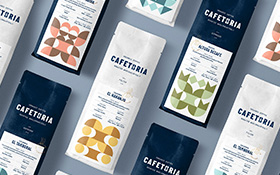
Does BioPouches make custom coffee bags?
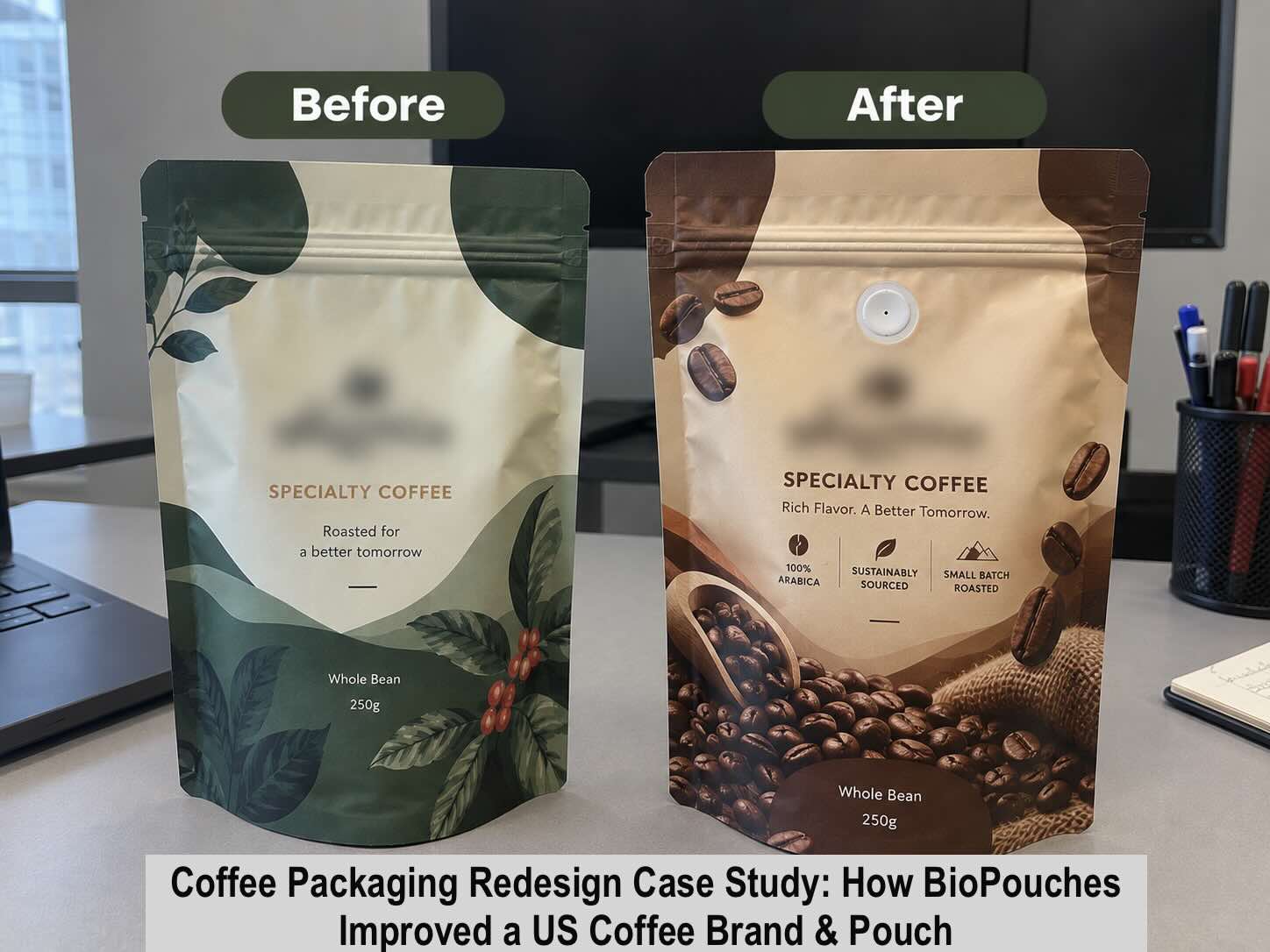
Yes. Our custom coffee packaging includes flat-bottom, stand-up, and gusseted coffee bags, with resealable closures, and recyclable, compostable, or PCR material options where suitable for the project. Specific material and structure choices depend on the coffee product, its roast, and the required shelf life.
Can BioPouches add a degassing valve to coffee bags?
Yes. Freshly roasted coffee releases gases after roasting, and a properly specified one-way degassing valve allows that internal gas to escape while helping limit outside air from entering through the valve. A valve alone does not guarantee a specific shelf life; barrier structure, sealing quality, and storage conditions all still affect how long the coffee stays fresh. You can see this in practice on our coffee pouch with a degassing valve.
Does every coffee bag need a degassing valve?
No. A valve is generally useful for whole bean or freshly roasted ground coffee packed shortly after roasting, since that's when gas release is highest. Coffee that's been rested or degassed before packing, or products where the roaster is managing gas release another way, may not need one. Whether a valve is necessary is confirmed against the specific roast, packing timeline, and shelf life target rather than added by default.
Pet Food, Snacks and Other Applications
Does BioPouches manufacture pet food packaging?
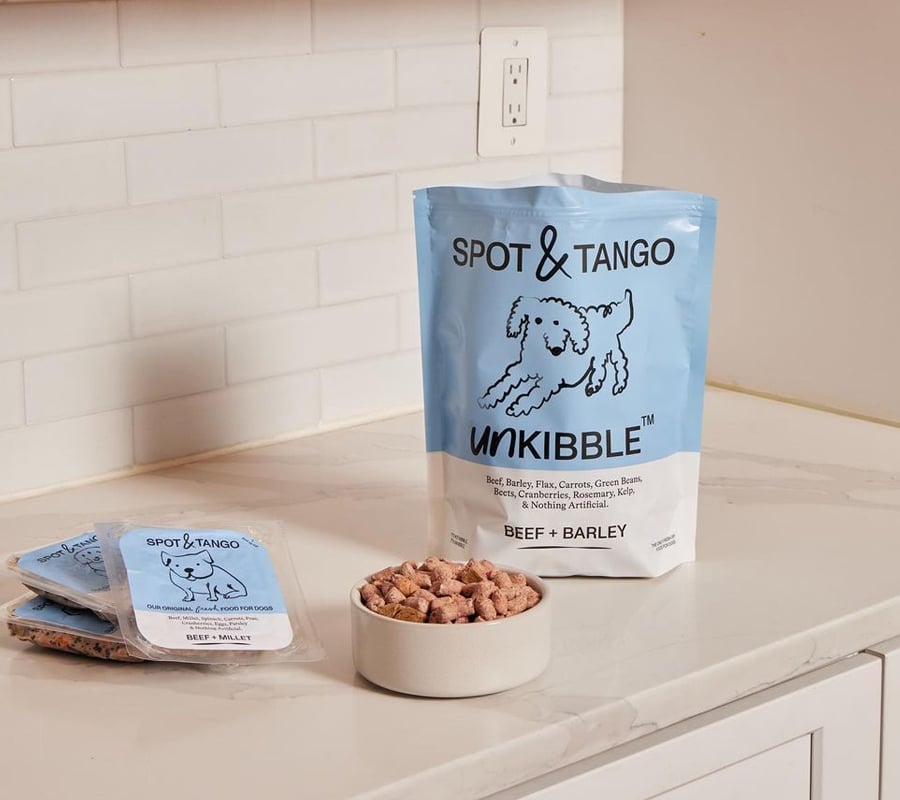
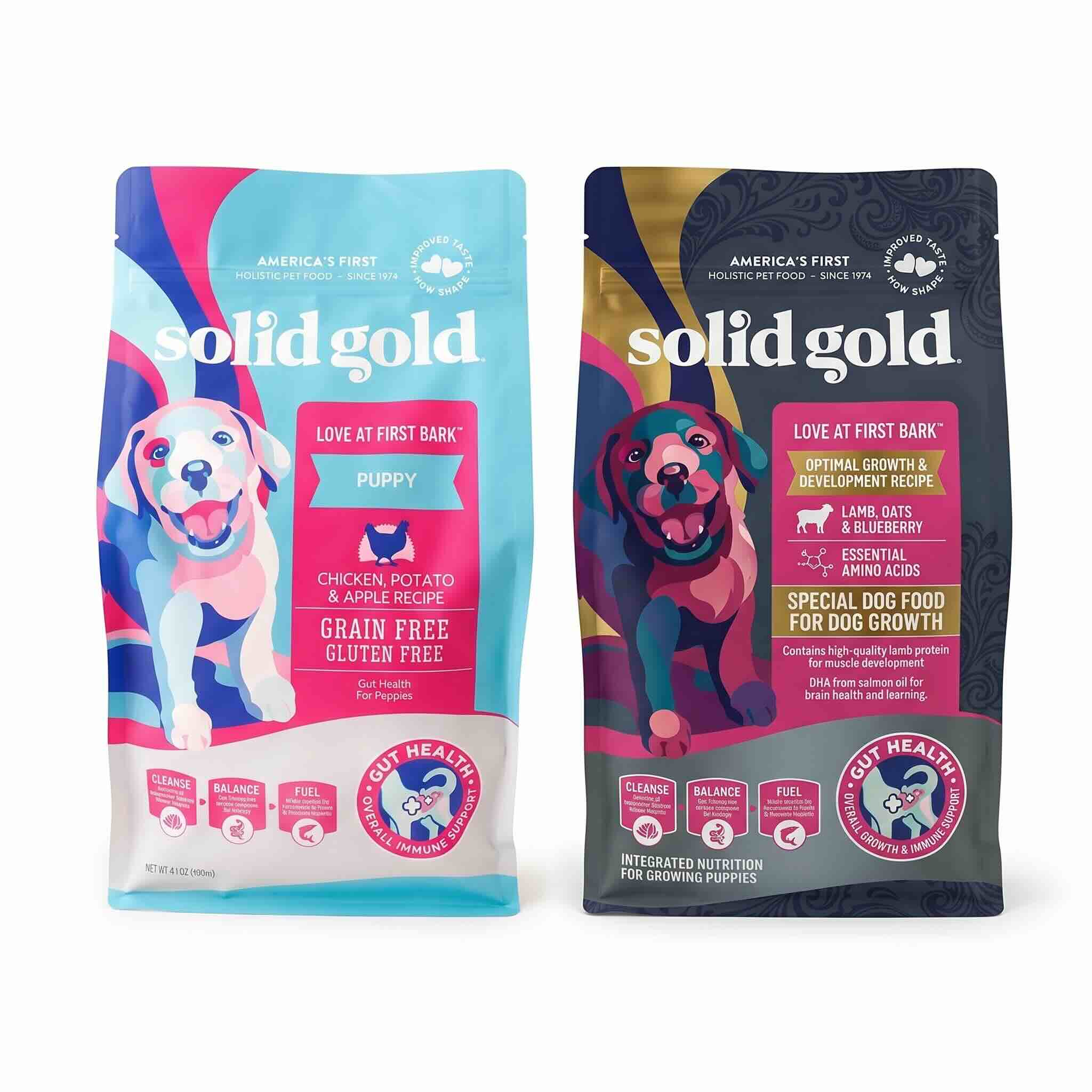
Yes. Our pet food packaging includes stand-up pouches, flat-bottom pouches, side-gusset bags, and flat pouches. Format and material selection depend on fill weight, fat or oil content, moisture sensitivity, puncture resistance needs, closure requirements, and distribution conditions, since no single structure suits every pet food product. Our pet food pouch packaging guide covers these tradeoffs in more detail.
Why does pet food packaging vary so much by fill weight?
Larger dry pet food fills, several kilograms and up, place significantly more mechanical stress on a pouch than a small treat bag does, which is why flat-bottom and side-gusset formats are more commonly used at higher weights than small stand-up pouches. High-fat pet food formulations also generally need a stronger oxygen barrier than lower-fat products, since fat oxidation is a primary driver of rancidity and shortened shelf life. These factors are evaluated together for each product rather than applied as a single fixed specification across an entire pet food line.
Does BioPouches make packaging for snacks and jerky?
Yes. Our snack and jerky packaging is specified differently depending on the product. Chips, cookies, nuts, dried foods, and jerky each carry different requirements around oxygen barrier, moisture barrier, grease resistance, breakage protection, and resealability, so specifications are set per product rather than applied uniformly across the whole snack category.
Does BioPouches manufacture frozen-food packaging?
Yes, within our broader range of packaging applications. Frozen-food packaging is selected around low-temperature performance, seal integrity, puncture resistance, and the specific product and distribution conditions involved. Not every BioPouches pouch structure is automatically suitable for freezing; this is confirmed for the specific product during specification, since a film or seal that performs well at room temperature can behave differently once it's repeatedly frozen and thawed.
Does BioPouches offer health and beauty packaging?
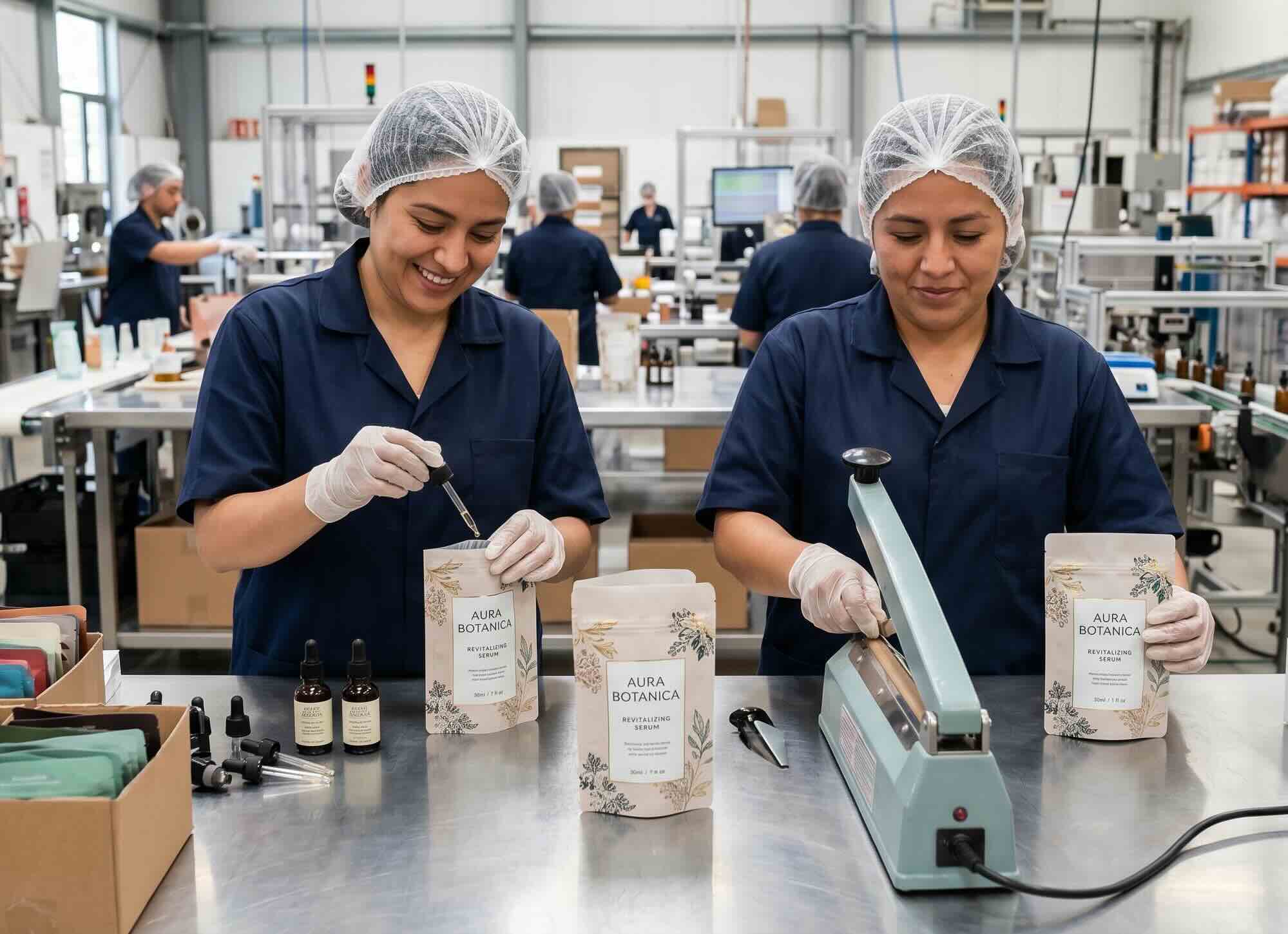
Yes, for suitable dry products such as bath salts, powders, soaps, and certain cosmetic or personal-care formulas. Compatibility depends on the specific formula, since a standard pouch structure isn't automatically suited to every liquid, oil, or chemical product without confirming direct contact compatibility first. Products with active ingredients, fragrance oils, or moisture-sensitive powders are evaluated individually to confirm the packaging material won't react with or degrade the formula over time.
Materials and Sustainability
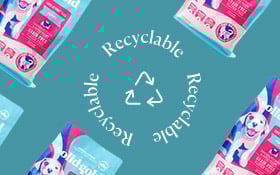
Does BioPouches offer recyclable pouches?
Yes, including mono-material approaches for suitable applications. See our recyclable packaging options for details. A pouch being designed for recyclability does not guarantee it will be accepted by every local recycling program, actual recyclability depends on the finished structure and the collection and recycling infrastructure available where the product is sold.
Does BioPouches offer compostable pouches?
Yes, we offer certified compostable products within specific certification scopes. Not every BioPouches pouch is compostable, and compostable does not automatically mean home compostable. Compostable packaging also does not simply disappear safely in nature; it requires specific composting conditions to break down as certified.
Does BioPouches offer PCR packaging?
Yes, where suitable for the application. PCR (post-consumer recycled) packaging incorporates material recovered from previously used products or material streams. PCR is not automatically biodegradable or compostable unless that property independently applies to the specific structure used.
What is the difference between recyclable, compostable and PCR packaging?
These are three distinct material strategies, not interchangeable terms. Recyclable packaging is designed to be processed through existing recycling streams, subject to local infrastructure. Compostable packaging is certified to break down under defined composting conditions within its certification scope. PCR packaging incorporates recycled material content but is not automatically recyclable, compostable, or biodegradable on its own. The right route for a given project depends on the product, its material requirements, and the sustainability goals involved.
Can recyclable, compostable and PCR materials be combined in one pouch?
Not always, and this depends heavily on the specific structure. A pouch built primarily as a mono-material recyclable structure may not be able to also incorporate a compostable layer without compromising the recyclability of the finished pack, since recycling streams generally require the material to be sortable as a single type. PCR content can sometimes be incorporated into a recyclable structure, subject to how it affects seal performance and clarity. These combinations are evaluated case by case rather than assumed to work together by default.
Certifications
Is BioPouches BPI certified?
BioPouches LTD holds BPI Certificate #10529578-1, issued September 14, 2026 and valid until August 31, 2029, using ASTM D6400 and BPI's certification requirements. This certification applies only to the specific products within its documented scope, not to every BioPouches pouch. Full detail is available in our BioPouches BPI and DIN certifications documentation.
Does BioPouches hold DIN CERTCO registrations?
Yes. BioPouches LTD holds DIN CERTCO registrations 7P1758 and 9G0527, covering industrial compostable packaging bags under DIN EN 13432:2000-12 as the testing basis, both valid until June 30, 2028. TÜV Rheinland (Shanghai) Co., Ltd. is identified as the testing and inspection body. These registrations apply within their documented scope rather than to every BioPouches product.
Customization and Ordering
What information should I provide for a custom pouch quote?
Sharing the product being packaged, an approximate fill weight, and your intended order quantity gives our team enough to start narrowing down the right specification. See the detailed checklist further down this page for the full list of details that help most.
Can I request packaging samples?
Yes. Sample requests are a normal part of the process before committing to production, since a sample lets you confirm the material, printing, and structure work with your actual product before finalizing an order. For products with specific barrier or compatibility concerns, we'd recommend testing the sample with the real product and, where relevant, under the storage or shipping conditions it will actually experience, rather than relying on the sample's appearance alone.
Can BioPouches handle multiple SKUs or design variations in one order?
Yes, and this is one of the practical reasons digital printing is often a good fit for brands with several flavors, sizes, or seasonal designs. Because digital printing avoids the plate-based setup that gravure requires, running multiple designs within a smaller total order is generally more workable than it would be on a gravure line, where each additional design typically adds setup cost and lead time.
Why should material selection happen before mass production instead of after?
Confirming material and structure before a full production run reduces the risk of discovering a barrier, seal, or compatibility issue only after a large quantity has already been made. This matters more for products with specific protection needs, high-fat foods sensitive to oxidation, moisture-sensitive powders, or products with a long shelf-life claim, where the wrong film structure isn't something that shows up until well after the product has shipped. Testing a sample against the real product ahead of a production order is a more reliable way to catch this than assuming a structure will perform based on similar products alone.
Can a single pouch combine a resealable zipper, a valve, and a specific material route together?
In many cases yes, for example a recyclable coffee pouch with both a zipper and a degassing valve is a common combination, but each added feature needs to be checked against the others and against the base material. A valve and a zipper both introduce components that have to integrate with the film structure without compromising the seal or, where relevant, the pouch's recyclability. Combinations like this are confirmed during specification rather than assumed to work automatically together.
How do I choose the right pouch format for my product?
The right format depends on your product type, fill weight, required barrier properties, and how it will be displayed or distributed, rather than a single universal answer. Our food packaging selection guide walks through these tradeoffs in more depth if you're still narrowing down which direction fits your product.
Where can I find paper tube packaging if BioPouches specializes in pouches?
For projects that need rigid, cylindrical paper-based packaging rather than a flexible pouch, our sister brand Earthycores specializes in custom paper tube packaging within the same XWPAK group.
How can I contact BioPouches about a custom project?
You can reach our team directly through our contact page to discuss your product, timeline, and packaging requirements.
What Information Should You Send BioPouches for a Custom Packaging Quote?
You don't need every technical specification worked out before reaching out. If you can share the product, intended quantity, and basic requirements, our packaging team can help narrow down the rest. That said, the more of the following you can provide upfront, the faster we can put together an accurate quote:
The product being packaged
Fill weight
Approximate product volume, where relevant
Preferred pouch format, if known
Required dimensions, if known
Estimated order quantity
Printing method preference, if known
Number of SKUs or designs
Desired material route (conventional, recyclable, compostable, or PCR)
Barrier requirements
Zipper or closure requirements
Valve requirements, if applicable
Window, hang hole, or tear notch requirements
Whether the packaging will contact the product directly
Filling and sealing method
Destination country
Target production timeline
Before Starting a BioPouches Project
The details covered on this page are a starting reference, not a substitute for confirming your specific project. Final pouch structure, material, size, printing method, barrier performance, closure, and any certification requirements should be confirmed for your individual product before moving into production.
If you're ready to talk through a project, or still working out which direction fits your product, you can contact BioPouches and our team will help you work through the specifics.
Flexible Packaging Expert at BioPouches
Asad Manan has over 6 years of hands-on experience in flexible packaging at BioPouches. He specializes in beauty product, Coffee, Food-Snacks, and health products packaging solutions that protect sensitive formulas and extend shelf life. With strong content writing skills, he creates practical guides to help brands choose the right packaging for stability, hygiene, and sustainability.
Latest News